Women in the Mafia

Women in the Mafia

(c)philipjehmann

I thought I’d offer a personal reflection on a certain strand of research I have been undergoing for our upcoming show, The Bloodline.
The Bloodline is inspired by the dynamics of power within criminal underworlds and their parallels to Shakespeare’s King Lear. We are asking how power is perceived and how power is sought. Do we yearn for hierarchical structure? What happens when this structure is thrown into turmoil?

Criminal underworlds present insular environments where power is intensified, where the threat of violence is immediate and everyone’s morals and motives are questionable. Many of Shakespeare’s texts explore power in different ways. His words and characters carry weight and gravity that provide a timelessness which we feel will provide an access point for an audience to the themes of power we wish to explore.

The Bloodline

(c)philipjehmann

We have delved into many paths of research on different organised crime gangs around the world and I must admit, the first thing that has struck me is that women are almost never mentioned in these contexts. At first it seemed as if women have never existed within these age old traditions of crime and power.

As a group, we are mostly concerning ourselves with the American Italian mafia and are becoming more and more influenced by the iconic gangster film genre. Its influence seems to be uncontrollably bleeding into our work, which we’re not minding at all at the moment but perhaps that’s for another blog. It is the American Italian mafia and the Italian mafia where I have been able to find an insight into the role of women, and its complicated web of changing traditions have become a real stimulant for me.

There are traditional mafia rules that formally excludes the participation of women in the criminal organisation. Only men of Italian descent are allowed to become members. The traditional role for mafia women are to be mothers and wives of Mafia members. They belong to the Mafia as opposed to being part of it. They are ‘Property of the Mafia’. It seems that Mafia women are expected not to ask questions about Mafia business and are actively kept out of the loop. Some writings tend to root that fact in catholic belief, the mother is Madonna – the pure being. But other reasons are suggested, that women become emotional over the dangers regarding their sons and husbands and that she will lose all objectivity.
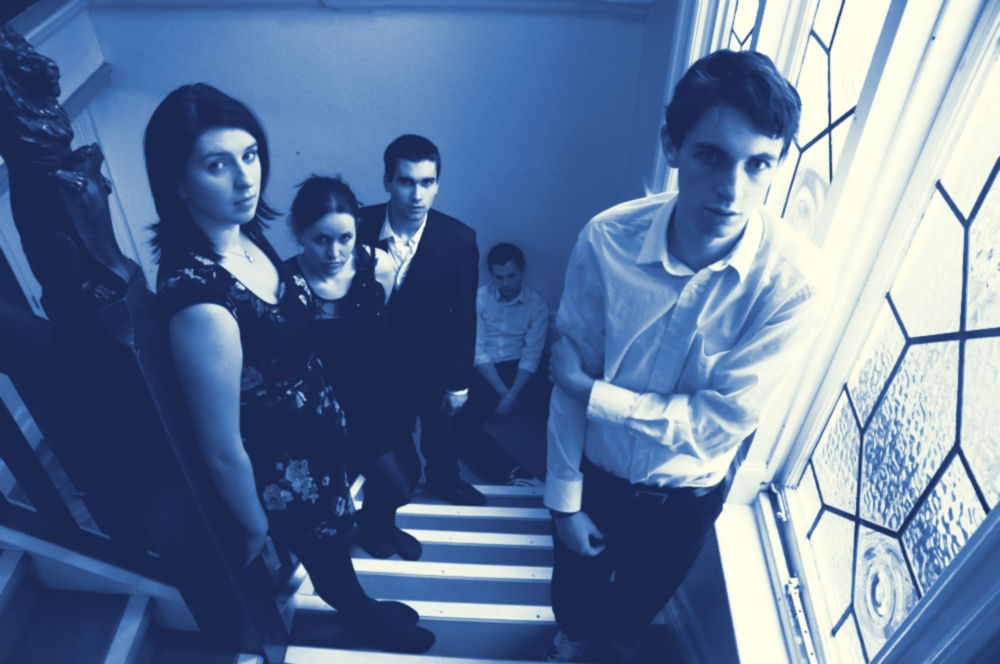
women in the mafia

(c)philipjehmann

It interested me how these traditions effect relationships with their husbands. “Pillow Talk” is regarded as a blatant violation of the code of absolute secrecy. It is believed that the reason mobsters take mistresses is to have a woman they are able to confide in.

We have been looking at these traditions and their parallels and contradictions with Shakespeare stories and it is when we have been looking at King lear that my imagination has gone wild! What happens when women of the mafia somehow are presented with a high position of power and the responsibilities and choices that come with it.

We have been aware that in the last few decades women’s roles in the Mafia have begun to change. Now that Mafia women get educated, they have become more active in the criminal organisation and are let into the secrets. They have become book-keepers and messengers. Karen Hill, a character in Goodfellas is a good example.

There are rare examples of women who have began to take power when their husbands and brothers have been sent to prison or have been forced to go on the run. Many of these women have proved themselves by running a successful and equally brutal regime. However, no female is yet to be appointed by virtue of their own leadership qualities. They have only delegate or substitute power. There has been no official change to the Mafia code in regards to female involvement.

I am wondering whether female liberation is happening in these rare examples of female leadership or whether women are performing an act of further obedience by allowing the Mafia system to continue during the absence of the male family members. These questions are allowing me to view King Lear through a new lense, especially the Goneril and Regan characters and their dynamic with Cordelia. I’m not sure yet how this research might manifest in the final product as we are always shifting ideas and evolving healthily but it’s proving a complex topic for me and I’m really enjoying exploring its possibilities in the rehearsal room.

Monique Luckman
Looking back at our First Project as SourDough Theatre!

We found this little recording this week of our first project as a company, Wings, Wasps and Feathers. It was a shadow puppet show made to entertain the families at the Falconry Festival at Poltimore House back in the Summer. We had a lot of fun with this little story that we created in keeping with the falconry theme of the day. The story tells of two birds who through their fight against a very intimidating swarm of angry wasps who have invaded their home, the learn to work as a team. . . just like SourDough Theatre (there is a parallel in there somewhere . . . ish.)

2011

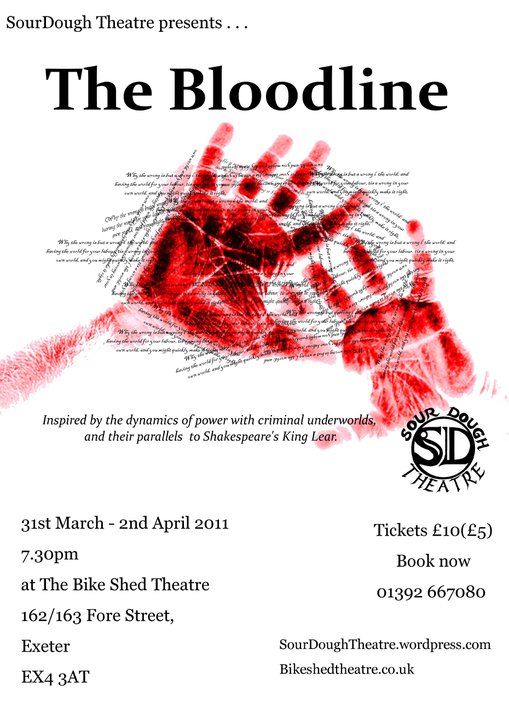
2011 is already shaping up to be a very exciting year for SourDough Theatre. We are currently deep into rehearsals for our upcoming show, The Bloodline, which is an adaptation of King Lear and, indeed, many things Shakespeare. Our emphasis with this show will be on the visual as we use The Bard’s text as another media (such as shadows or music). The framework we have been researching since 2010’s mince-pie fuelled fundraiser, A Christmas Carol, is that of underground organisations and the crime world. We are fairly confident that we can somehow find a place for Will’s words in this world. The Bloodline will be performed at The Bike Shed Theatre on 31st March – 2nd April.

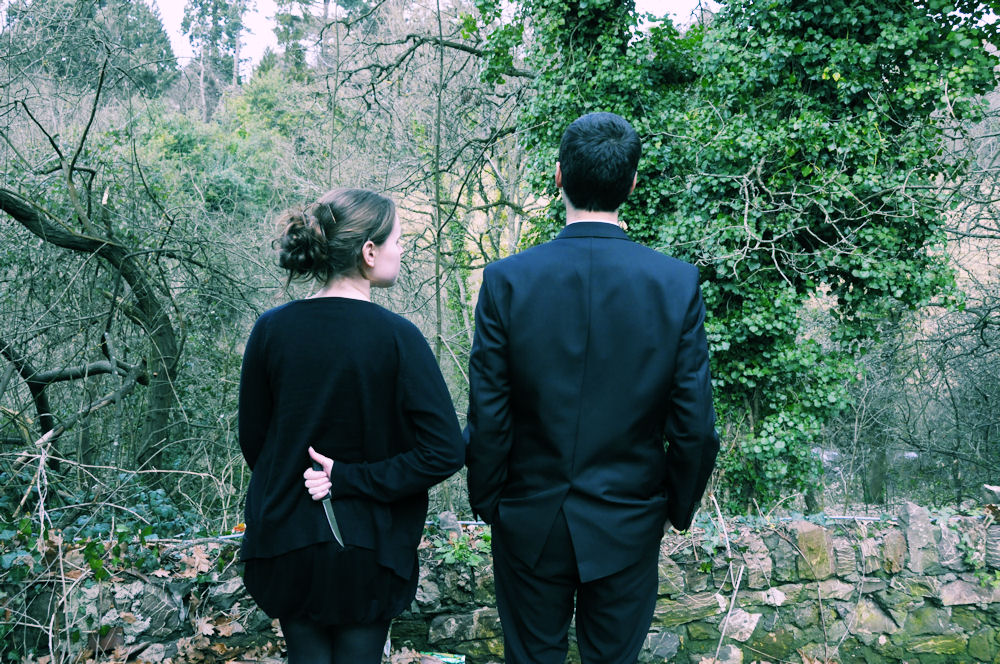
The Bloodline Poster

We have exciting news to do with the In The Flesh festival at The Barbican in Plymouth, where we will be showcasing a sneak-peek extract from The Bloodline. We will also be performing at the Tagore Festival at Dartington where we have teamed up with Jerri Daboo to create a new version of The Red Oleanders which we will taking to the festival (and possibly beyond?). We have put our names forward for a few other festivals and, if these applications pay off, 2011 will shape up to be a very interesting one.

With each New Year come (it seems) new opportunities and we have been talking long and hard about where to take the company as we finish off our first year of existence (and indeed what kind of theatre company we are). In light of this we are looking to take one of our shows (tbc-watch this space!) on a South West Summer Tour.

The Christmas Project

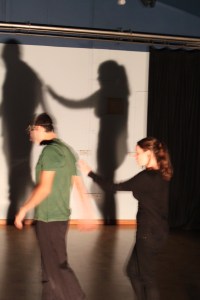
A Christmas Carol Shadow

I am very pleased to announce our Christmas project: our very own adaptation of the much loved Dickens Classic, A Christmas Carol. We will be performing for one night in St Stephen’s Church on the 18th December at 7pm. Join us as we journey through the story of ghostly shadows, chiming bells and Christmas morals. There will be carol singing, games and good old Christmas cheer!

The aim is to raise as much money for the St Stephen’s Project as possible so tickets will be a pay what you want price and all ticket sales will go to the project: http://www.stephenproject.org.uk/.

We are very excited to start working on this story, we love it because it is Gothic and ghostly as well very funny and warming. It will be a real giggle. So please come along, it would be lovely to see you.

Here’s something to wet your appetites

[youtube=http://www.youtube.com/watch?v=VsiKOJOXMJU]

A SourDough Halloween

Magic Shoes

Magic Shoes

On Sunday 31st October 2010, SourDough Theatre began a rehearsal in St Stephens Church in Exeter. Theatre makers or not, most people our age would usually spend Halloween in a number of places, be it pub, club or party. But for SourDough, All-Hallows-Eve  was the night before a mammoth get-in, technical rehearsal and, as is often the case with devised work, last-minute show-making! And as such it saw us move from one beloved rehearsal space into another:  St Stephen’s Church, to allow us to carry on into the night.

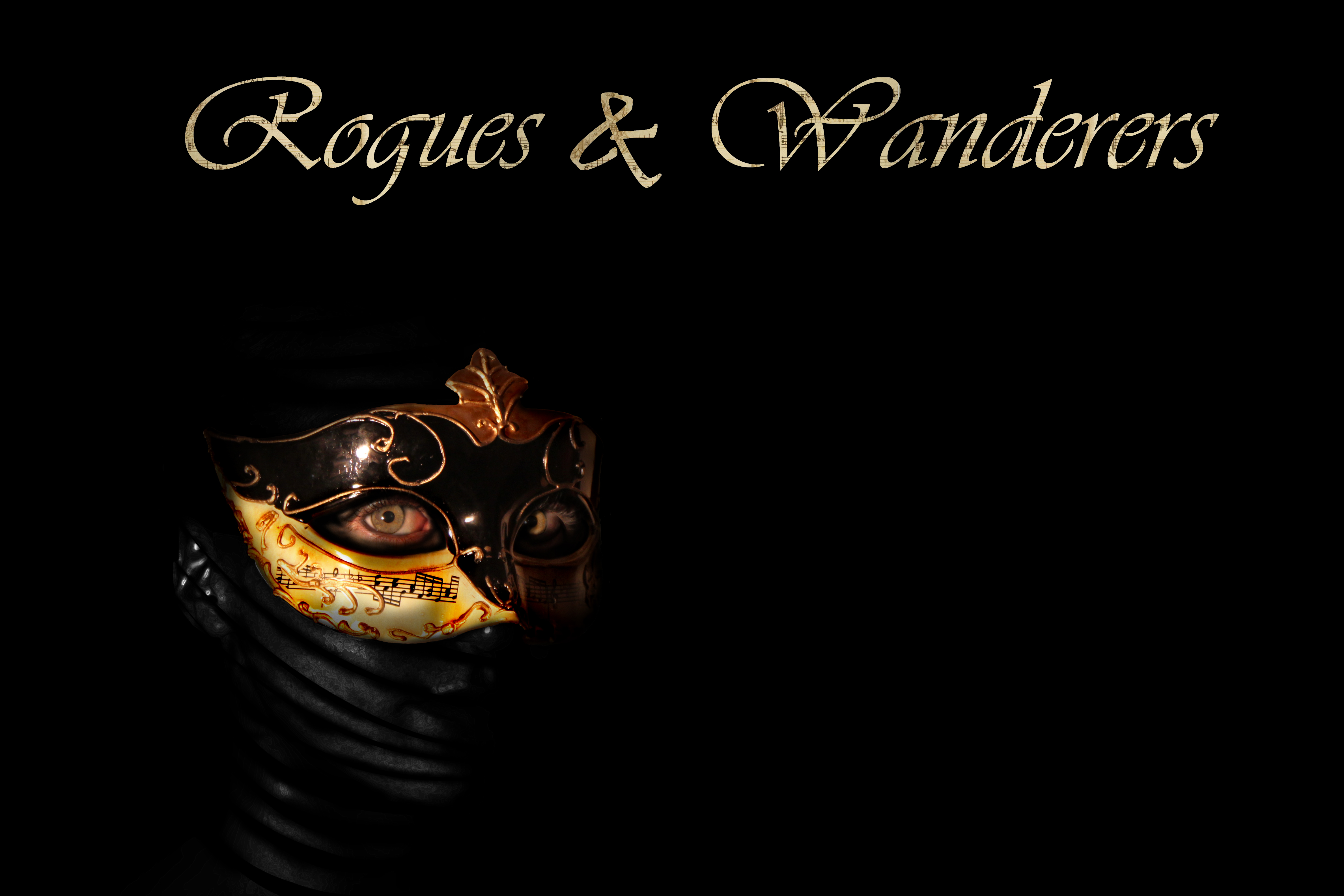
Whilst rehearsing for Rogues and Wanderers, we would use the church most Sunday evenings as our usually hang outs would be locked up. A couple of us in the company have used the church as a performance space for a previous project at University. We love the space, it is vast, cold and echoy and has a wonderful quite, ancient atmosphere even though it is located at the very centre of busy Exeter.

Mask Making

Mask Making

So, we were 2 days away from our opening night and we sat around a long grand table to discuss the piece as a whole in order to develop a plan of action for our all important last days of preparation. This discussion actually began to function as a way of sharing each of our thoughts about what the piece had become and how it had emerged. This was the point at which we began to feel tingles of excitement about showing it to an audience and a real connection with the piece had sprung into life in each of us and left us feeling really proud of it.

We decided to get up and use the massive space to run through the piece and apply some of the touch ups and improvements we had been talking about. Whether it was the hushed atmosphere of the church, or the air of halloween night, or the levels of excitement that was mounting in us, this run-through turned out to be full of energy and when it came to try our ending for the very first time, it was a very special moment indeed.

We had been preparing a song for the final section of the performance for a couple of weeks, and as singing in harmony had not came naturally to us as a group, it was something we had been working hard for and had been really enjoying. When we applied it to the piece in that rehearsal, it was the first time we had tried it without the much needed guidance of our wonderful, god-sent musicians. However the sound of our united voices in that vast, silent church was enough to move us into a humble contentment with the piece we had finally finished.

Shoes and Lights

Shoes and Lights

As we quietly packed away our belongings and left through the Church’s back door, the song still softly resonating  through our heads, there was a strange buzz that twisted through us all. It was born of the excitement that comes when the nights come swifter and the air turns colder; as the dwindling October hours and their Halloween masks stand on the cusp of bonfires, fireworks and Christmas trees. And sometimes, on wonderfully rare occasions, this autumnal electricity works its way through an unusual moment, like the one the eight of us shared in the old church. Never had any of us spent a Halloween quite like that one.

http://www.stephenproject.org.uk/

Monique Luckman and Joe Sellman-Leava

Masks and Music

Masks and Music

The Importance of Feedback

On Wednesday, we held a work in progress performance for some of our heroes. We invited our old lecturers, tutors and mentors from the University to come and see some of the material we have so far with the hope that they can offer us feedback and comment with fresh eyes on the what parts are working and what bits aren’t and how to push the piece further.

This is something we had been planning to do from right at the beginning of our rehearsal process. We wanted to do it for a number of reasons. In our experience of devising and performance making, it is easy to become precious and introvert about what your making and sometimes that is dangerous as it is easy to become too immersed in the process and lose sight of the an audience’s  journey through the piece.

Another reason is that, in devising, it is always vital to get fresh eyes on the work as they will always be able to pick up on something that you haven’t seen yourself and the feedback will tell you which aspects of the performance are working better and which aspects aren’t. This feedback then provides you with a new, fresh direction to push and develop your piece.

And this is exactly what happened. After a week of working on moments that have been born through play and work-shopping, we were beginning to develop a journey/narrative through these series of moments. But as we began to do this, I had started to feel my grip on what someone experiencing these moments for the first time will see slipping away. But just as I started to feel this, it was time for the work in progress session. Brilliant timing.

The feedback took the form of a lively discussion about physical language, relationships with text, sensual experience and how narrative and meaning is currently emerging. The discussion was fruitful and energetic and has therefore us given a revitalised energy to move on in our process.

The performance date is getting closer now and it is becoming more and more important that we don’t lose our energy and excitement for the piece and continue to work hard pushing and shifting and questioning and challenging. We have found that feedback helps you maintain that energy to keep running.

Monique Luckman

The meaning of Sour Dough

Shadow WorkshopWhile studying at university one of the common phrases thrown around during any devising process was that people shouldn’t be afraid of “killing babies”. Obviously this wasn’t meant literally, it of course meant that when creating work ideas should be treated as just that; ideas. An idea can change and shift, grow or shrink, or gotten rid of altogether. Every idea that is created through exercises or discussions should not be considered set in stone but in fact seen as something malleable. This is where we got the name “SourDough”.

Dough can be moulded, expanded, baked, shaped, stretched, added too and taken away from. Consider an idea as a piece of dough while making bread. Sometimes the dough is too big to fit in the tin before going in the oven and bits needed to be taken away but those bits would never go in the bin, but saved until the next loaf of bread needs to be made.

So here we have two different approaches to devising, killing your babies and making dough. For a while I simply stopped talking about babies and completely focused on my dough and every idea that was aired was treated as such, however over the course of Rogues and Wanderers the difference between the two has become totally clear to me, and has brought babies back on my mind.

Sometimes it is necessary to let ideas go completely. And these ideas are difficult to use in a future piece, a future loaf. A rule of a particular world for example which would not fit in any other project. However, a theatrical devise (like a box of matches, that can be used in so many different ways to achieve so many different affects) which can be moulded to fit another piece is dough, and if it does not fit in the piece that you are doing at that particular moment it should be wrapped up in cling film and put in the fridge. It is sometimes difficult to see the difference between the two and most of the time it is only in hindsight that the dough can be taken from the babies, but realising what can be saved is important. Killing a baby is sometimes hard work and people can find it difficult to let go of precious ideas, but if you look at it as dough that can be used again the disappointment is greatly reduced.

Ideas as DDancing with Shadowsough was introduced to us during a module in our second year by our tutor, we greeted it with giggles. However as time goes on, and we get more and more experienced with devising work the phrase has stuck with us and has now become an integral part of our language during our process.Shadows at work
Callum Elliott-Archer

The process so far . . .

This week's rehearsals

This week has been a tough week for everyone in the group. We are getting to that very recognisable stage in the process where we are rehearsing every day and working very hard and long, at times we are losing sight and finding it hard to distance ourselves from the project. It is ticking away constantly with everyone. As I say, a very recognisable state for a devising process.

Rehearsal with Masks

Rehearsal with Masks

Even though tensions have been high at times, frustrations and feelings that we haven’t achieved enough have occurred; some really important and strong work has come out of this week.

It is important to mention that in previous weeks, as a group, we have been focussing on the structure of the piece, the ‘world’ we are trying to create and the rules within it (‘world’: a word some of us, if not all would like to never hear again once the piece is done), and the characters that we would like to emerge. This has meant hours and hours of discussion, filling holes and gaps, trying to make our concept and structure flawless. This is something we know is impossible, you can pick holes in any story; there will always be something that hasn’t been thought of or over looked. However, it’s important to try.

So there have been weeks of diagrams and brain storms, endless evaluation of the ‘classic structure’ and referencing literally every film ever made; The Matrix, Narnia, The Beach, Labyrinth, The Village, The Truman Show, Hook and The Wizard of Oz being some of our most used to make a point or to make sense of things. An impressive mix, I think.

This week, we have moved on. We have allocated characters and roles for everyone, which in fact took the form of another endless discussion but we have arrived at a point where there is excitement amongst us to what each of us will be able to achieve in our roles.  We have a very creative group of performers which means there is a wealth of possibility. This is an encouraging idea for us.

Text Work

Text Work

With characters allocated, we have been able to start work on important moments of interaction between characters, and pivotal moments in the story. By just starting to write, improvise and practically explore ideas, difficult decisions and concepts have magically answered themselves and we are beginning to generate some interesting material.

Character Workshop

Character Workshop

We have also managed to start work on movement. This has been useful because ideas about a character’s function and relationship with one another have come out whilst trying to discover how certain characters move. It’s funny how two birds can unexpectedly be killed with one stone in this way.

Next week, we are looking forward to working on ideas for live music within the piece and what role it might have. I, for one, am have excited about this. It is my belief that music in general has a unique ability to surround physical and visual work and lift it into becoming more present and vivid. So I’m hoping questions about tone and mood will be explored in workshops with live music. Perhaps it will be the topic of next week’s blog.

Monique Luckman